micropp
PipeDream: 1F1B Scheduling
- PipeDream accelerates pipeline parallelism by starting the backward pass for a microbatch as soon as its forward pass completes the final stage, enabling earlier disposal of cached activations.
- In the steady-state “1F1B” (1 Forward, 1 Backward) schedule, each device alternates between forward and backward passes. With 4 GPUs and 8 microbatches, at most 4 microbatches are in flight at any time, halving the same peak activation memory as GPipe.

- A microbatch is in-flight if we performed >1 forward pass for it, but haven’t completed all the backward passes yet.
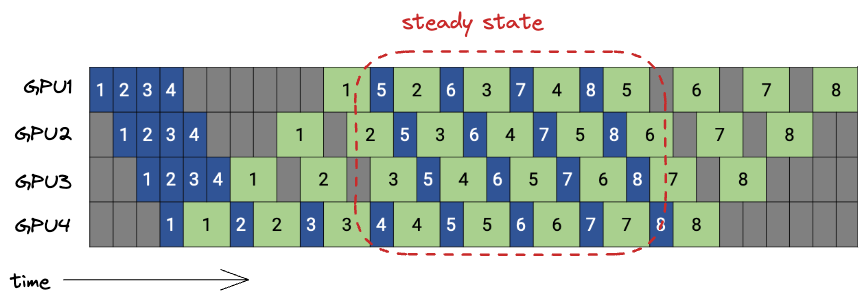
- Despite this memory advantage, the pipeline “bubble fraction”—idle time due to dependencies—is the same for GPipe and PipeDream because of the sequential dependency structure.
- Visually, looking at the above PipeDream plot if you shift the blue forward passes left and the green backward passes right, you get GPipe. This explains why the bubble fraction is the same.

Communication Volume
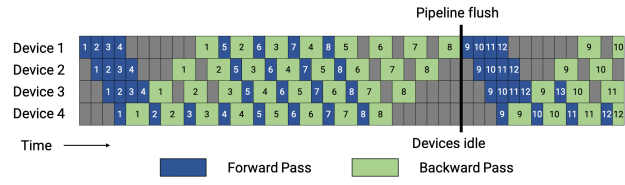
- Both GPipe and PipeDream require each GPU to send/receive
batch_size × Ndata per forward and backward, totaling approximately2 × (num_GPUs – 1) × batch_size × Nfloats per batch for a model of hidden sizeN.- The -1 terms comes from the initial GPU not having to receive and the last GPU not having to send anything.
Hypothetical Scenario
- If we had 100 micro-batches, GPipe would need 100x memory, but 1F1B would still only need about 4x. This is why we go through the trouble of the warm-up and cooldown!
Why 1F1B Needs Async Forward + Request Tracking
- Async forward sends (
isend_forward) - prevents deadlock - Save request handles (
async_requests.append(req)) - prevents buffer deallocation
Case 1: Blocking send_forward (DEADLOCK)
Rank 2:
- Blocked on
send_forward()for microbatch 1, waiting for Rank 3 to callrecv_forward() - Can’t call
recv_backward()for microbatch 0 because it’s stuck in the blocking send
Rank 3:
- Blocked on
send_backward()for microbatch 0, waiting for Rank 2 to callrecv_backward() - Won’t call
recv_forward()for microbatch 1 because it already finished forward(0) and moved to backward(0)
Result: Both are blocked sending, and neither can receive because:
- Rank 2 is stuck sending forward(mb1) and can’t receive backward(mb0)
- Rank 3 is stuck sending backward(mb0) and won’t receive forward(mb1)
This is why async isend_forward() is needed: Rank 2 can start the send and immediately proceed to run_backward(0) → recv_backward(), which unblocks Rank 3, allowing Rank 3 to eventually receive the forward(mb1) that Rank 2 started.
Case 2: Async isend_forward WITHOUT saving request (CRASH)
# Rank 0:
def run_forward(micro_batch_idx):
    output = model(input_data)
    req = comms.isend_forward(output.detach())  # Start async send
    # req is NOT saved anywhere
    # Function returns, req goes out of scope
    # Python GC may collect req object

# What happens inside Gloo:
# 1. isend() creates internal buffer reference to output.detach()
# 2. Send happens in background thread
# 3. req object is GC'd → Gloo loses reference
# 4. Gloo tries to access buffer → "Cannot lock pointer to unbound buffer"
# 5. CRASH
Why saving the request fixes it:
async_requests.append(req)  # Keep reference alive!
# Now req stays in scope until function returns
# Gloo can safely access buffer during async send
Case 3: Async isend_forward WITH saving request (WORKS)
# Rank 0:
def run_forward(micro_batch_idx):
    output = model(input_data)
    req = comms.isend_forward(output.detach())
    async_requests.append(req)  # ✅ Keep alive
    # req stays in async_requests list
    # Buffer reference stays valid
    # Gloo can complete async send safely

# Function returns, but async_requests is still in scope
# (it's a closure variable, lives until onef_oneb_pipeline_step returns)
# All sends complete before function exits
Key Insight
The request object returned by isend() contains a reference to the tensor buffer. If the request is garbage collected, Gloo loses that reference and crashes. Saving it in async_requests keeps the reference chain alive:
output.detach() → req object → Gloo internal buffer reference
     ↑                ↑
     |                |
  output_buffers  async_requests (both keep things alive)
Both references are needed:
output_bufferskeeps the originaloutputtensor alive (needed for backward)async_requestskeeps thereqobject alive (needed for Gloo’s buffer reference)