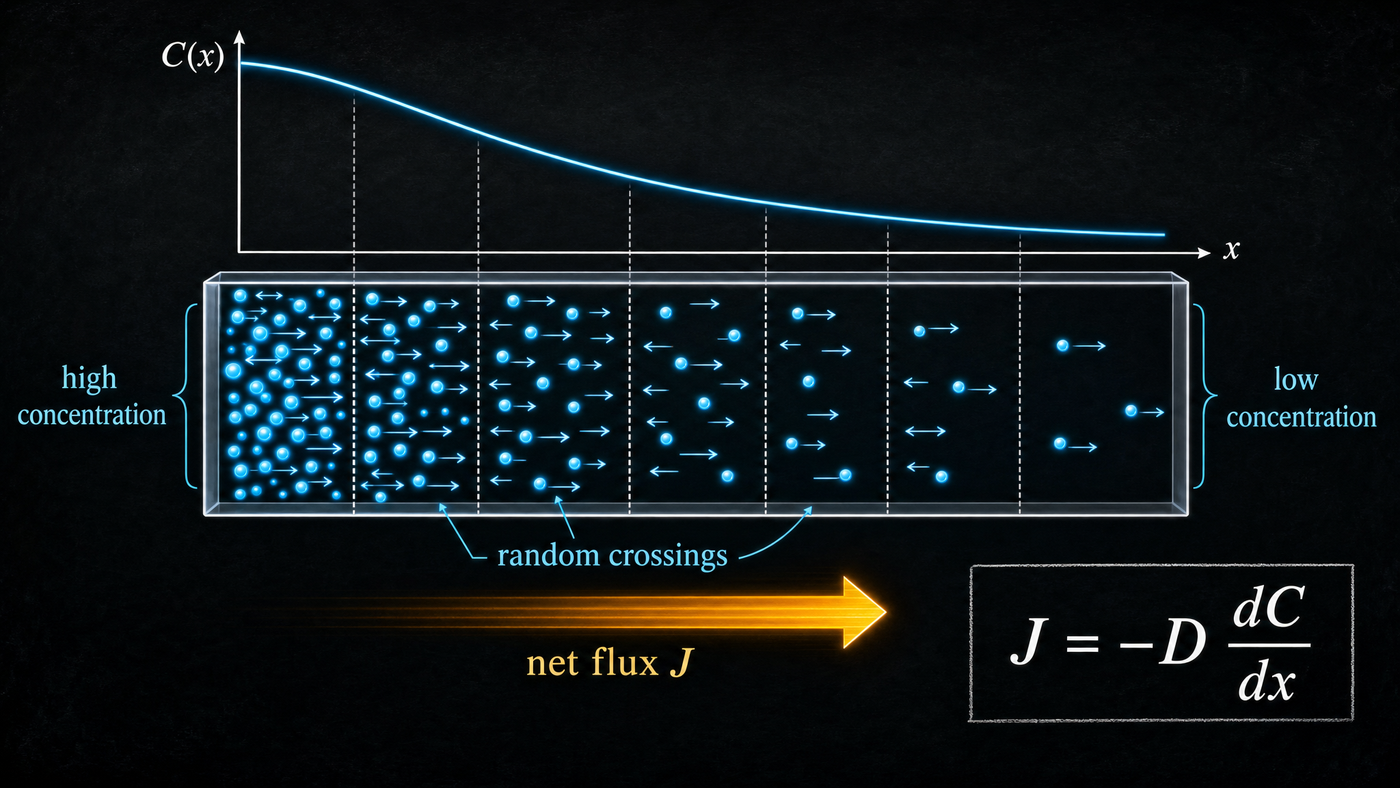
Imagine a square box divided into thin vertical slices. At the beginning, all the particles are packed into the slices on the left.
Each particle jitters randomly. In a tiny unit of time, some particles in each slice cross left and some cross right. No particle knows where the empty space is. There is no little wind pushing them toward equilibrium.
But if one slice has many particles and the slice to its right has few, then more particles will randomly cross from left to right than from right to left. Not because rightward motion is more likely for any one particle, but because there are more particles available to make the rightward trip.
So diffusion is directed in aggregate and random in detail. The left side drains, the right side fills, and the gradient flattens. Eventually each slice has about the same number of particles, so the crossings still happen, but the left-to-right and right-to-left flows cancel.
This is the microscopic intuition behind Fick’s law: net flow is proportional to the concentration gradient. The random-walk picture is also the same tradition as Einstein’s explanation of Brownian motion: macroscopic smoothness emerging from molecular randomness.