Chapter 12
Synthetic Data & Distillation
How models increasingly learn from other models, and why synthetic feedback now sits at the center of many post-training pipelines.
Synthetic data scales judgment
Human preference data is expensive and slow. Synthetic data lets a stronger model generate demonstrations, critiques, or comparisons at much larger scale.
That shift changes the economics of post-training and explains why modern pipelines can move quickly.
The core question becomes when model-generated supervision is good enough to trust.
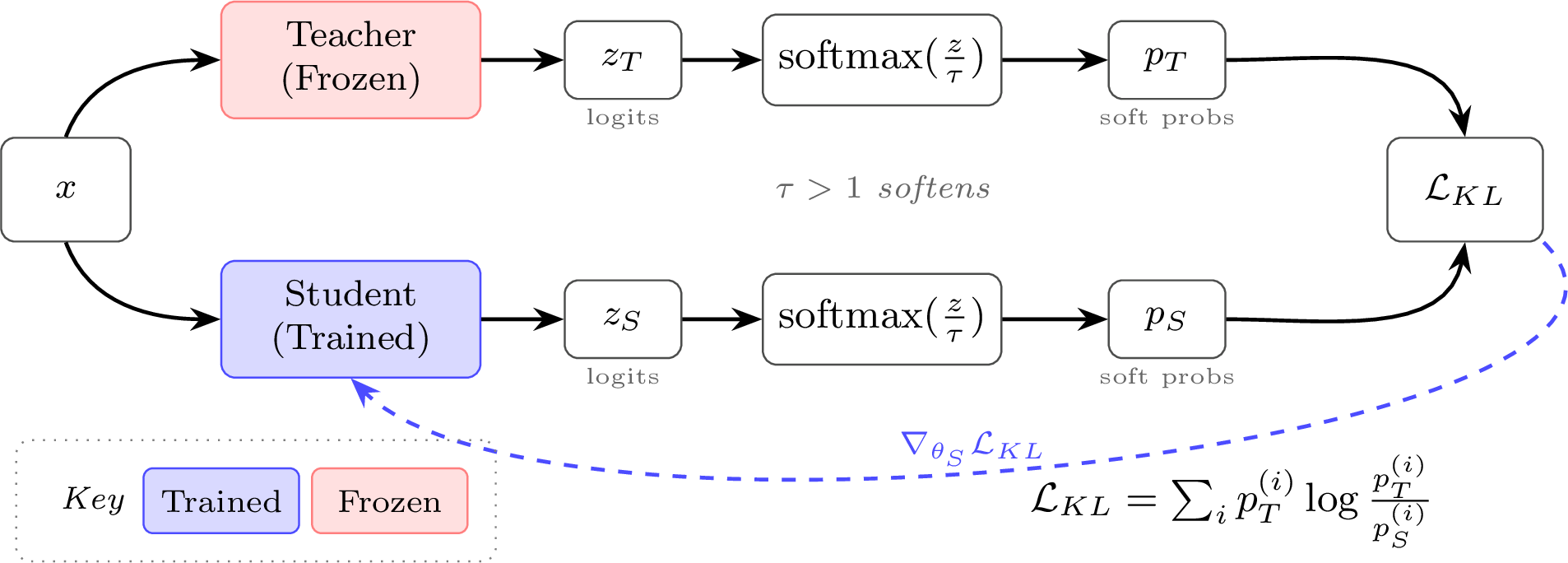
Distillation is capability transfer, not just compression
Distillation often means using a stronger teacher model to produce targets that a smaller or cheaper model can imitate.
In post-training, this can include demonstrations, synthetic preferences, rubric-based judgments, or constitution-style critiques.
So distillation is best viewed as a way of transferring behavior and judgment, not only logits.

Synthetic feedback is powerful because it is structured
Rubrics, constitutions, and explicit judge prompts make synthetic supervision more legible and easier to iterate on.
But every rubric imports the biases of the judge model and the prompt writer.
The bottleneck shifts from raw data volume to the quality of the synthetic teacher.
Review
5 quick checks
Questions with revealed answers.
1 Why is synthetic data so important in modern post-training?
Because it provides much more scalable supervision than relying only on expensive human labels.
2 What does distillation transfer in this setting?
Not just raw predictive skill, but behaviors, judgments, preferences, and reasoning patterns from a stronger teacher.
3 Why are rubrics useful in synthetic feedback pipelines?
They make the evaluation criteria more explicit and can improve consistency in model-generated judgments.
4 What new risk comes with relying on synthetic judges?
The pipeline can inherit the biases, blind spots, and prompt sensitivities of the judge model.
5 What is the central design question for synthetic post-training?
How much of the desired behavior can be safely delegated to model-generated supervision without drifting away from real user preferences.